
Academic Topics and Situations
The Office of Undergraduate Studies maintains resources on a variety of topics. Can't find something you're looking for? Email us at ugst@tamu.edu
Calculate Grade Point Deficit
If you have been placed on probation or blocked from your major, you will need to know what grades you will have in specific courses to reverse the situation. If you have been suspended from the university, knowing your grade point deficit gives you an idea of how far (or close) you are to completing a degree.
Your academic advisor can help you figure out your grade point deficit, and you definitely should consult your academic advisor when figuring out how to improve the deficit. You also can DIY figuring out the deficit.
To understand the grade point deficient, you first need to understand what grade points are. Grade points are one way to indicate your academic standing and progress. Every course is allotted grade points, and your GPA (grade point average) is determined by adding the grade points earned for each course and dividing by the total of hours taken.
Grade points for a particular course are calculated by multiplying the number of credit hours for that course by the numerical value assigned to the grade for that course (according to the 4.0 grade scale, below). Pass/fail courses (S/U) count in credit hours, but earn no grade points.
B – 3 points/hour
C – 2 points/hour
D – 1 point/hour
F – 0 point/hour
Example:
| Course | Credit Hours | Grade | Grade points/hour | Grade points |
| BIOL 111 | 4 | A | 4 | 16 |
| HIST 105 | 3 | C | 2 | 6 |
| KINE 199 | 1 | S | --- | --- |
| MATH 140 | 3 | D | 1 | 3 |
| ENGL 104 | 3 | F | 0 | 0 |
| Total | 14 | 25 |
25 Grade Pts/14 Credit Hours = 1.78 GPA
The grade point deficit is how many grade points you lack toward completing your degree with the minimum required 2.0 GPA. So, if your grade point deficit is -3, you need to pass three credit hours at a high enough grade to improve your grade point average to an acceptable level.
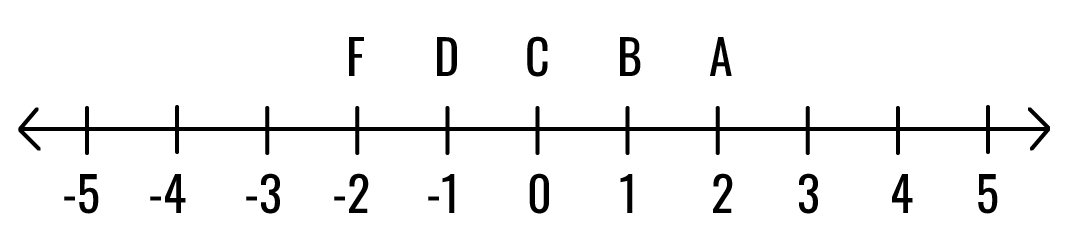
The number line below will help you figure out your grade point deficit.

B – 1 points/hour
C – 0 points/hour
D – -1 point/hour
F – -2 point/hour
To calculate the grade point deficit for a course, multiply the number line weight for the letter grade (for example, for a grade of D, select -1) by the number of credit hours for the course (for example, 3 credits). Do this for all your courses, then add up all the grade deficit for each course to get the total deficit. In the example above, the student with a 1.78 GPA has a grade point deficit of -3, as shown below.
Example:
| Course | Credit Hours | Grade | Grade Deficit (Number line) |
Grade deficit/course | |
| BIOL 111 | 4 | C | 0 | 0 | |
| HIST 105 | 3 | A | 2 | +6 | |
| KINE 199 | 3 | S | --- | 0 | |
| MATH 140 | 3 | D | -1 | -3 | |
| ENGL 104 | 3 | F | -2 | -6 | |
| Total | 14 | -3 |
If the total is a negative number, you are not in good academic standing.
|
positive total = good standing
negative total = probation or removal from major or university-level suspension |
To improve that deficit and get a positive total, you would need to make at least a B (+1) in a 3-credit course, as well as C’s in other courses.
Bottom line, if you are in a bad situation, the most important step you can take is a visit with your academic advisor.
Deans' Delegates
Bush School of Government and Public Service
| Undergraduate Deans' Delegates | Location/Bldg | Room | Phone | Mail Stop | |
|---|---|---|---|---|---|
| Dr. Bob Shandley | r-shandley@tamu.edu | Allen Building | 1112 | 979-458-8017 | 4220 |
| Andy Armstrong | andyarmstrong01@tamu.edu | Allen Building | 1112 | 979-458-7139 | 4220 |
| Clay Bryan | cbryan@tamu.edu | Allen Building | 2142 | 979-458-7194 | 4220 |
| Graduate Deans' Delegates | Location/Bldg | Room | Phone | Mail Stop | |
|---|---|---|---|---|---|
| Dr. Michelle Taylor | m-taylor11@pols.tamu.edu | Allen Building | 2139 | 979-845-8497 | 4220 |
| Clay Bryan | cbryan@tamu.edu | Allen Building | 2142 | 979-458-7194 | 4220 |
College of Agriculture and Life Sciences
| Undergraduate Deans' Delegates | Location/Bldg | Room | Phone | Mail Stop | |
|---|---|---|---|---|---|
| Dr. Mary Bryk | mary.bryk@ag.tamu.edu | Ag&LifeSci Bldg | 515 | 979-862-7620 | 2402 |
| Reid Stavinoha | reidstav@tamu.edu | Ag&LifeSci Bldg | 515 | 979-847-6180 | 2402 |
| Graduate Deans' Delegates | Location/Bldg | Room | Phone | Mail Stop | |
|---|---|---|---|---|---|
| Dr. Mary Bryk | mary.bryk@ag.tamu.edu | Ag&LifeSci Bldg | 515 | 979-862-7620 | 2402 |
| Reid Stavinoha | reidstav@tamu.edu | Ag&LifeSci Bldg | 515 | 979-847-6180 | 2402 |
College of Architecture
| Undergraduate Deans' Delegates | Location/Bldg | Room | Phone | Mail Stop | |
|---|---|---|---|---|---|
| Shelley Holliday | sholliday@arch.tamu.edu | Coke Building | 304EB | 979-845-7885 | 3137 |
| Dr. Katie Reed | kreed@arch.tamu.edu | Coke Building | 304EA | 979-845-6579 | 3137 |
| Ginger White | gwhite@tamu.edu | Coke Building | 304AA | 979-458-3042 | 3137 |
| Graduate Deans' Delegates | Location/Bldg | Room | Phone | Mail Stop | |
|---|---|---|---|---|---|
| Dr. Katie Reed | kreed@arch.tamu.edu | Coke Building | 304EA | 979-845-6579 | 3137 |
| Shelley Holliday | sholliday@arch.tamu.edu | Coke Building | 304EB | 979-845-7885 | 3137 |
| Ginger White | gwhite@tamu.edu | Coke Building | 304AA | 979-458-3042 | 3137 |
College of Arts and Sciences
| Undergraduate Deans' Delegates | Location/Bldg | Room | Phone | Mail Stop | |
|---|---|---|---|---|---|
| Dr. Wayne Versaw | wversaw@tamu.edu | Academic Bldg | 425b | 979-458-2417 | 3357 |
| Jason Henderson | hendersonjp@tamu.edu | Academic Bldg | 425a | 979-458-0549 | 3357 |
| Graduate Deans' Delegates | Location/Bldg | Room | Phone | Mail Stop | |
|---|---|---|---|---|---|
| Dr. Adam Seipp | aseipp@tamu.edu | Academic Bldg | 419 | 979-845-6456 | 3357 |
| Dr. David Kessler | david.kessler@tamu.edu | Academic Bldg | 423 | 979-458-0296 | 3357 |
College of Dentistry
| Undergraduate Deans' Delegate | Location/Bldg | Room | Phone | Mail Stop | |
|---|---|---|---|---|---|
| Maureen Brown | maureen.brown@tamu.edu | 3302 Gaston Ave., Dallas, TX | n/a | 214-828-8922 | n/a |
| Graduate Deans' Delegate | Location/Bldg | Room | Phone | Mail Stop | |
|---|---|---|---|---|---|
| Dr. Doug Gould | dgould@tamu.edu | 3302 Gaston Ave., Dallas, TX | n/a | n/a | n/a |
College of Education and Human Development
| Undergraduate Deans' Delegates | Location/Bldg | Room | Phone | Mail Stop | |
|---|---|---|---|---|---|
| Dr. Chris Cherry | chrischerry@tamu.edu | Harrington Tower | 107H | 979-458-3560 | 4222 |
| Kristy Anderson | kanderson@tamu.edu | Harrington Tower | 107G | 979-458-3560 | 4222 |
| Dr. Beverly Irby | beverly.irby@tamu.edu | Harrington Tower | 802D | 979-845-5311 | 4226 |
| Graduate Deans' Delegates | Location/Bldg | Room | Phone | Mail Stop | |
|---|---|---|---|---|---|
| Dr. Beverly Irby | beverly.irby@tamu.edu | Harrington Tower | 802D | 979-845-5311 | 4226 |
| Kristy Anderson | kanderson@tamu.edu | Harrington Tower | 802 | 979-845-5311 | 4222 |
| Dr.Chris Cherry | chrischerry@tamu.edu | Harrington Tower | 107H | 979-458-3560 | 4222 |
College of Engineering
| Undergraduate Deans' Delegates | Location/Bldg | Room | Phone | Mail Stop | |
|---|---|---|---|---|---|
| Dr. Angie Hill Price | price@tamu.edu | ZACH | 530 | 979-862-3243 | 3127 |
| Laura Olivarez | laura.olivarez@tamu.edu | ZACH | 530 | 979-458-5979 | 3127 |
| Graduate Deans' Delegates | Location/Bldg | Room | Phone | Mail Stop | |
|---|---|---|---|---|---|
| Dr. Duncan M. "Hank" Walker | d-walker@tamu.edu | ZACH | 530 | 979-845-9017 | 3127 |
| Tandilyn Morrel | tmorrel@tamu.edu | ZACH | 452 | 979-845-6883 | 3127 |
College of Marine Science and Maritime Studies
| Undergraduate Deans' Delegate | Location/Bldg | Room | Phone | Mail Stop | |
|---|---|---|---|---|---|
| Dr. Donna C. Lang | langd@tamug.edu | GALVESTON; Bldg 3034 | 403L | 409-740-4419 | n/a |
| Graduate Deans' Delegates | Location/Bldg | Room | Phone | Mail Stop | |
|---|---|---|---|---|---|
| Dr. Peter van Hengstum | vanhenp@tamug.edu | GALVESTON; Ocean and Coastal Studies Bldg. | 383 | 409-740-4919 | n/a |
College of Nursing
| Undergraduate Deans' Delegates | Location/Bldg | Room | Phone | Mail Stop | |
|---|---|---|---|---|---|
| Todd Stricherz | stricherz@tamu.edu | HSC Campus/HPEB | 3014 | 979-436-0153 | 1359 |
| Graduate Deans' Delegates | Location/Bldg | Room | Phone | Mail Stop | |
|---|---|---|---|---|---|
| Todd Stricherz | stricherz@tamu.edu | HSC Campus/HPEB | 3014 | 979-436-0153 | 1359 |
| Dr. Matthew Sorenson | msorenson@tamu.edu | Clinical Bldg. 1 | 3035 | 979-436-0141 | 1359 |
College of Performance, Visualization, and Fine Arts
| Undergraduate Deans' Delegates | Location/Bldg | Room | Phone | Mail Stop | |
|---|---|---|---|---|---|
| Christine Bergeron | cbergeron@tamu.edu | O&M Building | 202 | 979-845-5025 | 3237 |
| John Abi-Najm | johnabinajm@tamu.edu | O&M Building | 202 | 979-458-6987 | 3237 |
| Graduate Deans' Delegates | Location/Bldg | Room | Phone | Mail Stop | |
|---|---|---|---|---|---|
| Christine Bergeron | cbergeron@tamu.edu | O&M Building | 202 | 979-845-5025 | 3237 |
| John Abi-Najm | johnabinajm@tamu.edu | O&M Building | 202 | 979-458-6987 | 3237 |
College of Veterinary Medicine and Biomedical Sciences
| Undergraduate Deans' Delegates | Location/Bldg | Room | Phone | Mail Stop | |
|---|---|---|---|---|---|
| James Herman | jherman@tamu.edu | Vet. Med. Bldg 1/VENI | n/a | 979-862-7765 | 4461 |
| Juan Rodriguez | j.rodriguez@tamu.edu | Vet. Med. Bldg 1/VENI | 306M | 979-845-4122 | 4461 |
| Graduate Deans' Delegates | Location/Bldg | Room | Phone | Mail Stop | |
|---|---|---|---|---|---|
| Dr. Mike Criscitiello | mcriscitiello@cvm.tamu.edu | Vet. Med. Bldg 1/VENI | 317W | 979-845-5092 | 4461 |
| Dr. Ashley Seabury | aseabury@cvm.tamu.edu | Vet. Med. Bldg 1/VENI | 317P | 979-845-6820 | 4461 |
Mays Business School
| Undergraduate Deans' Delegates | Location/Bldg | Room | Phone | Mail Stop | |
|---|---|---|---|---|---|
| Wendy Castro | wcastro@mays.tamu.edu | Wehner Bldg | 238 | 979-845-3558 | 4118 |
| Patrick Williams | pwilliams@mays.tamu.edu | Wehner Bldg | 238 | 979-862-8501 | 4118 |
| Dr. Shannon Deer | sdeer@mays.tamu.edu | Wehner Bldg | 240X | 979-575-3851 | 4113 |
| Graduate Deans' Delegates | Location/Bldg | Room | Phone | Mail Stop | |
|---|---|---|---|---|---|
| Michael Alexander | malexander@mays.tamu.edu | Wehner Bldg | 390 | 979-845-4714 | 4117 |
| Dr. Jerry Strawser | jstrawser@mays.tamu.edu | Wehner Bldg | 385A | 979-458-6715 | 4117 |
| Dr. Shrihari Sridhar | ssridhar@mays.tamu.edu | Wehner Bldg | 440 | 979-845-4711 | 4113 |
| Dr. Rogelio Oliva | roliva@tamu.edu | Wehner Bldg | 440L | 979-862-3744 | 4113 |
School of Public Health
| Undergraduate Deans' Delegate | Location/Bldg | Room | Phone | Mail Stop | |
|---|---|---|---|---|---|
| Dr. Donald J. Curtis Jr. | dcurtis@tamu.edu | 147 E Reynolds | 163D | 979-436-9403 | 1266 |
| Graduate Deans' Delegates | Location/Bldg | Room | Phone | Mail Stop | |
|---|---|---|---|---|---|
| Dr. Rhonda Rahn | rrahn@tamu.edu | SPH Admin Bldg | 167 | 979-436-9426 | 1266 |
| Dr. Mark Benden | mbenden@tamu.edu | SPH Admin Bldg | 282 | 512-341-4927 | 1266 |
Campuses:
Higher Education Center at McAllen (HECM)
| Undergraduate Deans' Delegate | Location/Bldg | Room | Phone | Mail Stop | |
|---|---|---|---|---|---|
| Dr. Sandra Hansmann | sandra.hansmann@tamu.edu | HECM; 6200 Tres Lagos Blvd | 316.6 | 956-540-8546 | n/a |
Academic Affairs and other units:
Education Abroad
| Undergraduate Deans' Delegate | Location/Bldg | Room | Phone | Mail Stop | |
|---|---|---|---|---|---|
| Dr. Holly Hudson | hhudson@tamu.edu | Pavilion | 1st Floor | 979-845-0544 | n/a |
Honors, Undergraduate Research, National Fellowships
| Undergraduate Deans' Delegates | Location/Bldg | Room | Phone | Mail Stop | |
|---|---|---|---|---|---|
| Dr. Jon Kotinek (Honors) | jkotinek@tamu.edu | Henderson Hall | 222 | 979-845-6333 | 4233 |
| Dr. Gisele Cardoso de Lemos | giseleclemos@tamu.edu | Henderson Hall | 206 | 979-862-2258 | 4233 |
| Annabelle Aymond | annabelle.aymond@tamu.edu | Henderson Hall | 214 | 979-458-0039 | 4233 |
Office for Student Success
| Undergraduate Deans' Delegate | Location/Bldg | Room | Phone | Mail Stop | |
|---|---|---|---|---|---|
| Dr. Arthur Watson | acwatson@tamu.edu | Hotard Hall | 3rd Floor | 979-845-5916 | 4247 |
Transition Academic Programs
| Undergraduate Deans' Delegates | Location/Bldg | Room | Phone | Mail Stop | |
|---|---|---|---|---|---|
| Dr. Arthur Watson | acwatson@tamu.edu | Hotard Hall | 3rd Floor | 979-845-5916 | 4247 |
| Sherrice King | sherricek@tamu.edu | Hotard Hall | 3rd Floor | 979-845-5916 | 4247 |
| Dr. Karl Mooney | kpmooney50@tamu.edu | Hotard Hall | 3rd Floor | 979-845-5916 | 4247 |
Dismissal
What is dismissal?
Undergraduate students who are dismissed will be asked to leave a college or program, but not the university. If you have been dismissed, you should become familiar with two important Student Rules:
- University Student Rules, Academic Rules, 12. Scholastic Deficiency/Probation
- University Student Rules, Academic Rules, 50. Academic Suspension and Blocks
What does it mean to be dismissed?
If you have been dismissed from a major, a program, or a college, it means you have not met their academic requirements. This could be because of a semester GPA, a culumative GPA, the grade in a required course, or other reasons as outlined by your major, program, or college. Do not assume that if you fall below requirements you will be put on probation. Probation is not automatic, and some college do not have probation. Once you have been dismissed, you will need to find another major or college. Your can get help with a change of major from your academic advisor.
How can I appeal a dismissal?
Go back to the letter or email you received that announced your dismissal. It will tell you about two processes and give you contact information for each. Pay close attention to the deadlines.
If you believe that the decision to dismiss you was arbitrary, prejudiced, or capricious, you can appeal to the Undergraduate Academic Appeals Panel. If you believe that is the case, follow Student Rule 57. However, if you simply have not met the requirements for your major, degree, or program, it is unlikely that you were dismissed for any arbitrary, prejudiced, or capricious reason.
What should I do if I am dismissed?
Start by figuring out what caused your academic problems in the first place. Some students identify poor study habits, lack of preparation, excess social activity, or work outside of classes as contributors. Some discover their major is the problem. Perhaps their understanding of the major and the aptitude for the work required is different from what they expected. Or they lack interest or skill in a major. The best place to start figuring out what to do is by visiting your academic advisor. They will be able to help you pinpoint the issues and see what other major might work. if you cannot get help from your academic advisor, visit with the advisors in Transition Academic Programs, who have a wide knowledge of the requirements of many majors.
If you have fewer than 60 hours total taken in your degree plan, you might be able to take advantage of the General Studies major at Transition Academic Programs. With this major, you can complete one or two semesters of course work if order to prepare to transfer into a new major. There is a process you have to follow to be accepted as a General Studies major, including selecting a realistic major and sometimes a backup major. TAP advisors will help you though the application process. Be sure to pay close attention to their deadlines.
How can I improve my academic performance and improve my chance for re-admission to my major or college?
To identify problem areas and change your behaviors, talk to your academic advisor. Your advisor might refer you to the Career Center, University Health Services or the Academic Success Center. These resources can help you pinpoint the factors that helped lead to the situation and identify strategies to move forward.
Final Exam Conflict
I have three finals scheduled for the same day! How do I get them rescheduled?
If you have three or more final exams scheduled for the same day, you may request that your instructors reschedule one so that you have no more than two in one day. However, keep in mind that your instructors are not obligated to grant your request. According to Student Rule 8.4:
|
In those instances where a student is scheduled for three final examinations in one day, the student may request to reschedule one of the exams. The procedure and associated form for this request are available at the Undergraduate Studies web site. The student must initiate the request(s) no later than ten workdays before the first day of TAMU final exams. The same procedure, form and deadline applies to Blinn TEAM students and students enrolled in other co-enrollment programs where final examinations between institutions conflict.
|
What is the process for requesting rescheduling?
If you wish to request that your instructors reschedule a final exam, (Student Rule 8: Rescheduling a Final Exam) follow the steps below.
1. Ensure that you are making this request no later than ten work days before the first day of TAMU final exams.
2. Complete this form identifying the three course sections and scheduled exams that occur in one day.
3. Print out your class schedule and the final exam schedule.
4. Send a copy of this form and your class schedule to your instructors and work with them to reschedule one of the exams.
5. If none of the three instructors agree to reschedule or if you do not hear from them, contact your Dean’s delegate at least 5 business days before the first scheduled final exam, and include the following:
a. Copy of your class schedule and exam schedule
b. A completed Final Exam Conflict Form
c. Any communication or other information, if available, showing you asked all three instructors to reschedule
The Dean’s delegate will work with your faculty to reschedule one of the exams and contact you.
What if I need to reschedule for another reason besides having three or more finals in one day?
Rescheduling for any reason other than a three-in-one-day conflict must be worked out with your instructor.
What if I need to reschedule exams during the semester?
Student Rule 8.4 pertains only to final exam conflicts. If you have conflicts during the semester, you can speak to your instructors, but your best strategy is to plan your study time well. You can get help with that from an academic coach at the Academic Success Center.
How do I find the deans' delegate for my dean's office?
We have a list of delegates on this resource page. If you're still unsure, you can ask your academic advisor or contact us at ugst@tamu.edu.
What if I need more help or information?
If you have questions about filling in the form, contact the Undergraduate Studies Ombuds, Dr. Lori Moore, at UndergradOmbuds@tamu.edu.
No Grade Request
Administrative removal of posted grades requires approval by the Dean or designee of the college in which the student was enrolled during the semester in which the courses were taken. A NG requires extensive documentation of the extraordinary circumstances justifying the No Grade. The student's academic advisor, instructor of record, or the instructor’s department head if the instructor is unavailable, will be consulted during the process. The registrar will, if possible, notify the instructor of record, and in any event will notify the instructor’s department head, whenever a NG is issued.
Courses that receive a final grade of NG are excluded from the GPA calculation. Further information can be found in Student Rules 10.3, 10.11, and 10.23.
Please note that a No Grade Request can take up to a full semester to completely process. Your college may expect that you have successfully completed one or more semesters before processing a No Grade request.
Scholastic Probation
What is scholastic probation?
Undergraduate students who are placed on scholastic probation (also called academic probation) should become familiar with the following:
- University Student Rules, Academic Rules, 12. Scholastic Deficiency/Probation
- The terms of probation that are outlined in the probation letter or e-mail from the dean of the student's college
Student Rule 12 and the notification of probation provide the final word on probation and the expectations the college has for students on probation. You can learn more about probation from this Undergraduate Studies YouTube video.
What does it mean to be on probation?
Probation is special permission by your college or department to continue at Texas A&M for one semester even though you have not met the academic requirements to remain. If you are on probation, you will receive notification, usually a letter or an e-mail from the dean of your college.
The letter will outline the terms of probation—special things that must be done in order to remain at TAMU for one more semester. Terms of probation often include meeting grade requirements, registering in specific courses, meeting regularly with an academic advisor or an academic coach, or attending an academic assistance program. Terms might also include a restriction on future pre-registration.
You should consider probation as the final warning from the college. It's imperative that you fulfill the terms of probation. Failure to meet the terms and continued grade deficiency will result in serious consequences, including possible dismissal from your college or suspension from the university.
What if I don't meet the terms of probation?
Not meeting the terms of probation will have serious consequences. Students who do not meet the terms of probation will be dismissed from the college. Continued grade deficiency may result in suspension from the university.
What should I do if I am placed on probation?
If you have been placed on probation, take a hard look at your academic history and behaviors and determine what might have caused your poor academic performance. Some students identify poor study habits, lack of preparation, excess social activity, or work outside of classes as contributors. Some discover their major is the problem. Perhaps their understanding of the major and the aptitude for the work required is different from what they expected; perhaps they lack interest or skill in their major. In many cases, a change of major will be necessary, though this might be impossible while you are on probation.
Finally, consider the time and cost of attending Texas A&M University and the personal commitment necessary to be successful. Sometimes students realize they are incapable of making the commitment required to be successful at Texas A&M and wisely take a break from their studies here before experiencing further academic failure. If this applies to you, discuss this option with an academic advisor, along with options of continuing your education at another institution (on either a temporary or permanent basis). An academic advisor can also help you prepare for possible re-enrollment or re-admission to Texas A&M University if you take a break.
How can I improve my academic performance and get off probation?
To identify problem areas and change your behaviors, talk to your academic advisor. Your advisor might refer you to the Career Center, University Health Services or the Academic Success Center. These resources can help you pinpoint the factors that helped lead to the situation and identify strategies to move forward.
Suspension
What is a university-level academic suspension?
Undergraduate students who are suspended at the university level must leave the university for a period of 12 months and are permitted to re-apply for admission to return to Texas A&M after that 12-month period. Application for re-admission though the Office of Admissions is required, and acceptance is not guaranteed. During the suspension period, you will not be a Texas A&M student and will have limited access to Texas A&M resources.
If you have been suspended, you should become familiar with two important Student Rules:
- University Student Rules, Academic Rules, 12. Scholastic Deficiency/Probation
- University Student Rules, Academic Rules, 50. Academic Suspension and Blocks
You can learn more about suspension from the Undergraduate Studies YouTube video "Appealing a Suspension."
What does it mean to be academically suspended at the university level?
If you have been suspended, it means you have not met the academic requirements of the university. Typically, if your cumulative GPA falls below a 2.0, you will be suspended. Suspension is for a 12-month period. Once the 12 months have passed, you have the right to re-apply for admission to the university, but your admission is not guaranteed.
How can I appeal a university-level academic suspension?
Refer back to the letter or email you received from your college dean that announced your suspension. It will tell you about two processes and give you contact information for each. Pay close attention to the deadlines.
If you want to appeal because of extenuating circumstances that affected your academic performance, for example, a prolonged or serious illness, you can appeal to your college.
If you believe that the decision to dismiss you was arbitrary, prejudiced, or capricious, you can appeal to the Undergraduate Academic Appeals Panel (UAAP). If you believe that is the case, follow Student Rule 57.
Request a hearing at the UAAP.
What should I do if I am academically suspended at the university level?
Consider the suspension time an opportunity to pause and re-evaluate your situation. What caused you to perform below expectations academically? Some students identify poor study habits, lack of preparation, excess social activity, or work outside of classes as contributors. Some discover their major is the problem. Perhaps their understanding of the major and the aptitude for the work required is different from what they expected. Perhaps they lacked interest or skill in their major. In many cases, you will need to request a new major if you re-apply to TexasA&M. The best place to start figuring out what to do is by visiting your academic advisor. He or she will be able to help you pinpoint the issues and see what other major might work. if you cannot get help from your academic advisor, visit with the advisors in Transition Academic Programs, who have a wide knowledge of the requirements of many majors.
How can I improve my academic performance and improve my chance for re-admission to Texas A&M?
To identify problem areas and change your behaviors, talk to your academic advisor. Your advisor might refer you to the Career Center, University Health Services or the Academic Success Center. These resources can help you pinpoint the factors that helped lead to the situation and identify strategies to move forward.
Undergraduate Studies Initiatives
In addition to the resources above, the Office of Undergraduate Studies oversees a variety of progamming.
George & Barbara Bush Foundation Travel Grant
The George & Barbara Bush Foundation generously provides annual travel grants to Texas A&M undergraduates.
The Office of Undergraduate Studies facilitates educational travel opportunities for full-time undergraduates in amounts up to $750 per student. Grants support travel to academic conferences, research projects or study, and internships or study in the United States or abroad.
Announcements detailing grant availability are made each fall by colleges.
For questions or details, contact Jacob Miller at jacobmiller@tamu.edu.
Instructions for students:
Applicants must complete a George & Barbara Bush Foundation Travel Grant Application. You should submit the grant to your department head in your major (e.g. if you are in Biology, send it to the department head for Biology). Your application will be reviewed by the department. If it is selected to move forward, it will then be reviewed by the college, who will forward it to Undergraduate Studies for processing.If you are chosen as a nominee for the grant, you will be notified via email and physical mail before the university closes for the Winter Break. You will not receive a notification if your application was not selected.
Travel must take place in the associated calendar year, not fiscal or academic year. For example, if you apply in Fall 2026, this means that your travel must be scheduled to occur sometime between January 1, 2027 and December 31, 2027.
If you have received the grant and your travel plans change for any reason (conference is cancelled, inclement weather, etc.), contact Jacob Miller at jacobmiller@tamu.edu.
Can't find what you're looking for?
Every situation is unique, and your specific academic issue or circumstances may not be reflected on this page. Email us at ugst@tamu.edu. If we can't help you, we'll find someone who can.
Contact Undergraduate Studies